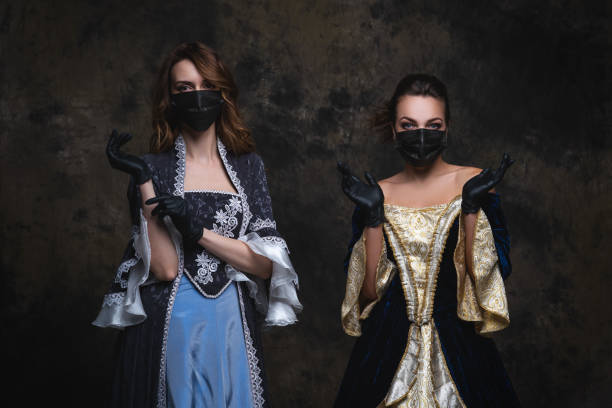
The moment you slip on a flowing cape, something remarkable happens to your spine. Your shoulders pull back, your chin lifts slightly, and suddenly you’re walking with the bearing of royalty or superhero confidence. This isn’t imagination – it’s neuroscience in action. The relationship between costumes and posture reveals a fascinating aspect of human psychology that extends far beyond mere dress-up, touching on everything from evolutionary biology to modern performance therapy.
Historical Foundations of Clothing and Movement
Physical anthropologists have long understood that clothing influences movement patterns. Traditional garments evolved not just for protection or modesty, but to facilitate specific activities and social roles. The restrictive corsets of Victorian era women didn’t just create an idealized silhouette – they fundamentally altered breathing patterns, gait, and gestural vocabulary. Similarly, the armor of medieval knights wasn’t merely protective; it required specific movement patterns that became ingrained in the wearer’s muscle memory, influencing everything from how they mounted horses to how they gestured during conversation.
Modern costumes tap into these same neurological pathways through what researchers call “embodied cognition” – the idea that our physical state directly influences our mental and emotional experience. When we don costumes that suggest specific character traits or historical periods, our bodies automatically begin to adopt corresponding postures and movement patterns, often without conscious awareness.
The Biomechanics of Transformation
Consider the transformative power of high heels. Beyond their obvious effect on height, heels fundamentally alter the body’s center of gravity, forcing the pelvis to tilt forward and the spine to compensate with an increased lumbar curve. This creates what biomechanics experts call a “power posture” – chest out, shoulders back, head high. The psychological effects are measurable: studies have shown that people wearing heels report feeling more confident and are perceived as more authoritative by others.
The cape phenomenon extends this principle even further. Flowing garments create what costume designers call “extension of gesture” – every movement becomes amplified and dramatized. The simple act of turning becomes a sweep, walking becomes gliding, and arm movements gain theatrical emphasis. Neurologically, this connects to our mirror neuron systems, which help us understand and embody the characteristics we observe or imagine.
Lessons from Historical Costume Reconstruction
Historical costume reconstruction has provided particularly rich insights into these posture-costume relationships. When historical interpreters don accurate period clothing, they often report spontaneous changes in their movement patterns. Corsets naturally encourage the “swan neck” posture favored in Renaissance paintings, with shoulders back and neck elongated. The heavy skirts of Georgian gowns require a specific gliding walk that minimizes vertical movement to prevent tripping. Men’s doublets from the same period push the chest forward and restrict shoulder movement, creating the proud, martial bearing depicted in period portraits.
Theater professionals have understood this costume-posture connection for centuries. Method actors often begin their character development process by exploring how their character’s clothing would affect their physicality. The weight of a character’s shoes, the restrictiveness of their collar, the flow of their sleeves – all of these elements inform how the character moves through space and, consequently, how they think and feel.
Scientific Research and Enclothed Cognition
Recent research in cognitive psychology has begun to quantify these effects more precisely. Dr. Hajo Adam’s groundbreaking work on “enclothed cognition” demonstrated that wearing specific types of clothing can actually improve cognitive performance in relevant areas. Participants wearing lab coats performed better on attention-related tasks, but only when they believed the coats belonged to doctors rather than artists. The physical sensation of wearing the costume, combined with its symbolic meaning, created measurable changes in brain function.
Therapeutic Applications
The implications extend into therapeutic applications. Physical therapists increasingly recognize the importance of addressing not just injured muscles or joints, but the complete movement patterns and postural habits that contribute to pain and dysfunction. Costume therapy – using specific garments to encourage proper posture and movement – has shown promise in treating everything from chronic back pain to social anxiety.
For individuals recovering from trauma, costumes can provide a safe way to explore different ways of inhabiting their bodies. Veterans dealing with PTSD sometimes use period costumes in historical reenactment as a form of embodied therapy, allowing them to experience their bodies in contexts removed from traumatic associations. Similarly, survivors of physical assault may find empowerment in costumes that encourage strong, confident postures – superhero costumes, period military uniforms, or fantasy warrior gear.
Modern Applications: Cosplay and Professional Development
The digital age has created new variations on these ancient patterns. Cosplayers often spend months not just creating accurate costumes, but studying and practicing the specific postures and movement patterns of their chosen characters. This physical preparation is considered just as important as visual accuracy. The most celebrated cosplayers are those who can fully embody their character’s physical presence, demonstrating how deeply costume and posture are intertwined.
Children’s costume play reveals these effects in their purest form. Watch a child put on a princess dress and observe how immediately their movements become more graceful and deliberate. Give them a superhero cape, and suddenly they’re standing taller, chest out, hands on hips in classic hero poses. These aren’t learned behaviors – they’re instinctive responses to the physical and psychological cues provided by the costumes.
The workplace applications are beginning to be explored as well. “Power dressing” has long been recognized in professional contexts, but newer research suggests that specific costume elements can be strategically employed to encourage desired behavioral changes. Structured jackets that encourage upright posture can boost confidence in public speaking situations. Flowing scarves or ties can encourage more expressive gesturing in creative presentations.
Considerations and Future Applications
However, there are also cautionary aspects to consider. Prolonged wear of restrictive period costumes can create muscle imbalances and movement compensations that persist even after the costume is removed. Professional performers and historical interpreters must balance authenticity with long-term physical health, often requiring specialized conditioning and movement training.
Understanding the costume-posture connection opens up fascinating possibilities for personal development and therapeutic intervention. By consciously choosing clothing elements that encourage desired postural changes, we can literally reshape not just how we move through the world, but how we think and feel about ourselves. The next time you notice how a particular outfit makes you feel and move differently, remember – you’re experiencing a fundamental aspect of human psychology that connects our most primitive instincts with our most sophisticated cultural expressions.