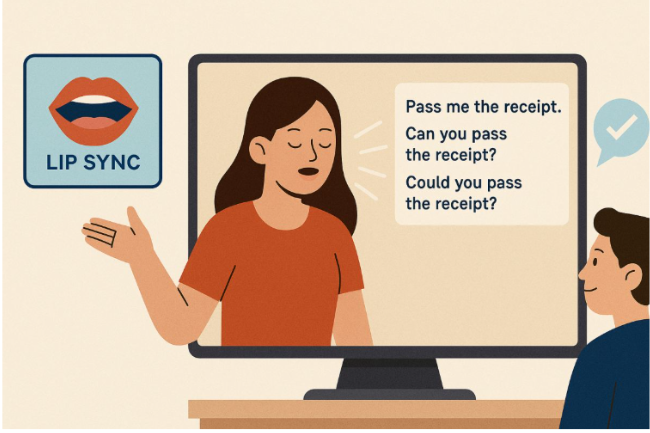
I teach grammar with video on the side—not the other way around. Short, well-chosen clips help students hear stress, see mouth shape, and test tone in real scenes. Two tiny helpers I keep on my toolbar come from GoEnhance AI: a simple lip sync video demo for articulation, and one playful effect, Kiss AI, that’s perfect for talking about register and context. I use each once at the start of a unit, then the class returns to writing and speaking.
What video fixes that worksheets miss
A page of rules rarely shows timing. Students ask, “Where do I slow down? Which word carries the weight?” A 20-second lip-synced line answers both questions. They watch the jaw drop on long vowels, see the lips pop on /p/ and /b/, and notice how unstressed syllables shrink. The grammar we teach—modals, aspect, conditionals—lands better once rhythm is clear.
Three quick wins:
- Stress becomes obvious. reCEIPT vs REceipt needs one look, not a speech.
- Linking stops sounding “lazy.” They see how pass_the forms a single motion, so commas don’t appear where a mouth never pauses.
- Politeness moves out of the abstract. A face, a glance, a half-smile: suddenly Could you… makes sense.
A five-step routine that fits any lesson (15 minutes)
- Pick one sentence you actually want them to say.
Could you pass the receipt, please? or I was hoping you could check this line. - Record the clean audio.
Your voice or a colleague’s—neutral pace, natural pitch. - Lip-sync and slow to 0.75×.
Students track three things: the main stress, any reductions (you → yə), and one piece of linking. - Give three grammar options.
- Pass me the receipt. (direct)
- Can you pass the receipt? (neutral)
- Could you pass the receipt, please? (polite)
Ask: which one fits a checkout line? a team stand-up? an email?
- Pass me the receipt. (direct)
- Write it, then say it.
In pairs, they write two versions of the same exchange—formal and casual—mark the stressed word, and read it with the clip on mute to check pacing.
That’s it. No tech show. The clip just makes the timing visible so the grammar choice sticks.
Pronunciation and writing belong together
I used to keep them apart. Now I pair them. After the lip-sync warm-up, students edit punctuation to match speech:
- commas where breath happens,
- a dash for self-correction,
- ellipses for hesitation,
- a full stop when the voice falls.
When they read the line aloud again, their writing looks cleaner because it sounds cleaner.
A simple reference table for your wall
| Skill | What to notice while watching | What to write on the page | One quick check |
| Primary stress | The syllable that opens the mouth widest | Bold or italicize one key word | Can you lower volume elsewhere without losing meaning? |
| Reductions | you → yə, going to → gonna (only where natural) | Use contractions that match register | Would you send this version to your manager? |
| Linking | pass_the, on_it | Avoid commas where the mouth doesn’t pause | Read once at natural speed—does the comma survive? |
| Intonation | rise for requests, fall for facts | End with ? or . accordingly | Record both endings; ask which one listeners hear |
Tape this table next to your board. It keeps feedback short and objective.
Using a “playful” effect to teach serious pragmatics
A romance-coded clip sounds silly until you ask the right questions. With Kiss AI, I don’t talk about “romance”; I talk about audience.
- Register. What wording changes in a brand ad, a friend’s text, and a workplace DM?
- Aspect and timeline. kissed vs was kissing vs has kissed—what moment does each suggest?
- Idioms. a peck on the cheek, blow a kiss, smooch—who uses which, and when?
I show 10 seconds on mute, then ask for three captions: formal, neutral, playful. Students learn that grammar carries tone long before they find “tone” on an exam.
Guidelines that keep creativity grounded in clear language
- Use stock faces or class-approved avatars. No personal uploads.
- Say when you’ve lip-synced and why: clarity, not trickery.
- Keep scenes PG and culturally safe; make differences across cultures part of the lesson, not a surprise.
- Store demo files locally; delete drafts when the unit ends.
The more boring your safety rules, the easier the teaching.
A one-week mini-unit (reusable every term)
Day 1 — Sound before rules.
Lip-sync a single sentence. Students mark stress and one reduction.
Day 2 — Same sentence, three registers.
Direct, neutral, polite. Vote on the best fit for three scenes.
Day 3 — Write for voice.
Pairs write a 60-second dialogue; they mark where they land the sentence.
Day 4 — Record and revise.
Sync the script to their lips, then adjust punctuation to match real speech.
Day 5 — Audience test.
Show a stylized clip. Groups write captions for: a PG trailer, a brand reel, a private chat. Explain choices.
Common snags and the quick fix
- Robot pace. Ask for “clear, not slow.” If in doubt, shorten the sentence.
- Too many targets. One reduction + one link + one stress per lesson.
- Perfect grammar, wrong audience. Always ask, “Who is this for?”
- No assessment. Use tiny checks: a 15-second read-aloud, one caption rewrite, a stress-marking quiz.
A tiny rubric you can grade in minutes
- Pronunciation (40%) — stress, pace, linking.
- Grammar (30%) — modal/aspect choice fits the meaning.
- Pragmatics (20%) — register matches the audience.
- Mechanics (10%) — punctuation mirrors speech.
Students see that the parts support one another; you grade without a Saturday lost to essays.
Final note
These tools don’t replace teaching; they remove friction. The lip sync video shows what your mouth is already doing. A short, stylized scene turns a “rule” into a choice about audience. Use one clip, keep it short, and push students back to speaking and writing right away. When timing is visible, grammar stops sounding like theory and starts reading like conversation.