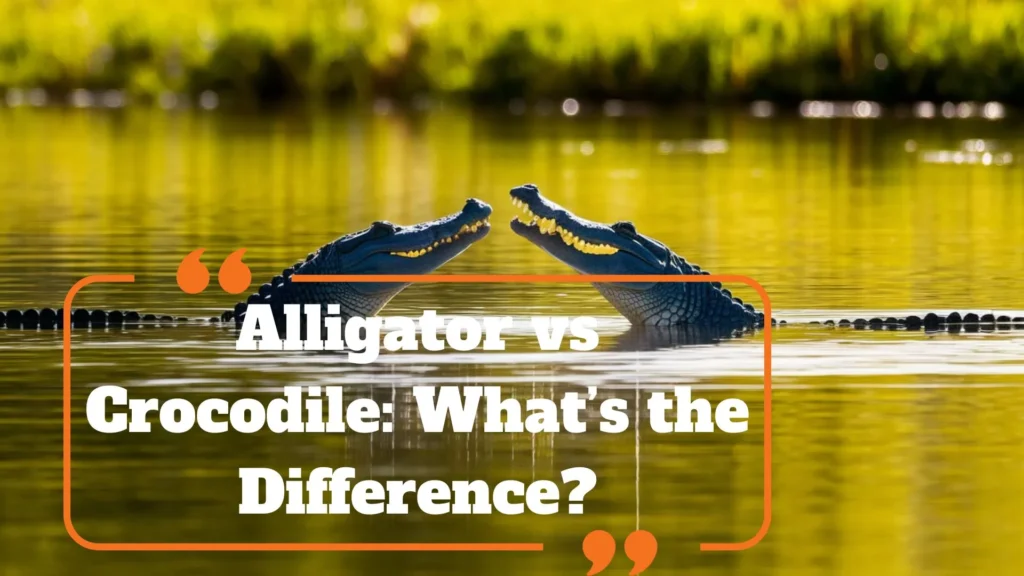
People get confused to tell the Alligator vs Crocodile because they have similarities, but a closer look reveals their distinct features. Both belong to the order Crocodylia, which includes lesser-known relatives like caimans and gharials. These ancient reptiles have a long evolutionary history, tracing back to the age of dinosaurs. If you’ve ever been to the Sunshine State, particularly the Everglades, you wouldn’t want to miss the chance to watch these big creatures in their natural habitats.
When comparing the two, their body structure shows noticeable differences. One of the easiest ways to differentiate them is by their snout shape—alligators have a broad, U-shaped snout, while crocodiles have a more pointed, V-shaped one. Their sizes also vary, with crocodiles generally growing larger. These predators use special sensors on their skin to detect pressure and movement in the water, which helps them hunt for their prey. Having taken several airboat tours in the Everglades, I’ve found it incredibly exciting to see them up front, especially when guides share tips on telling them apart.
Their habitats also play a major role in distinguishing them. Alligators stick to freshwater areas like swamps and rivers, while crocodiles can thrive in both freshwater and saltwater environments. That’s why you’ll find alligators almost everywhere in Florida, making them a familiar sight for Floridians who are used to sharing their state with these reptiles. The respect for their contribution to the ecosystem is clear, as they play a vital part in maintaining balance in their environment.
If you ever find yourself in a situation where you can’t tell which animal you’re looking at, knowing these separate traits will help. While some features may seem indistinguishable, understanding these details makes identification much easier. With their unique characteristics and powerful hunting skills, both of these deadly creatures remain some of nature’s most fascinating predators.
One of the easiest ways to tell an alligator from a crocodile is by looking at its body features. While they may seem similar at first glance, subtle distinctions make them easy to identify.
Snout Shape
- Alligators have a broad, U-shaped snout, which is ideal for crushing prey like turtles and shellfish.
- Crocodiles have a narrow, V-shaped snout, which is better suited for catching fish and small mammals.
A simple rule of thumb: U for alligator, V for crocodile.
Jaw Structure & Tooth Visibility
- When an alligator closes its mouth, its upper jaw hides all the lower teeth, giving it a cleaner look.
- When a crocodile closes its mouth, you can still see some lower teeth sticking out, especially the fourth tooth on each side.
This is because crocodiles have an interlocking bite, while alligators have a bite that conceals their lower teeth.
Size and Weight
| Feature | Alligator | Crocodile |
| Average Length | 8-12 feet | 12-17 feet |
| Max Recorded Length | 19 feet | 23 feet |
| Average Weight | 500-800 lbs | 800-2,200 lbs |
| Lifespan | 35-50 years | 70-100 years |
Crocodiles tend to be larger and heavier, but both species grow throughout their lives.
Coloration and Skin Texture
- Alligators are typically darker, almost black, which helps them blend into murky waters.
- Crocodiles are lighter with a tan, olive-green, or brownish hue.
- Crocodiles have rougher, scaly skin, while alligators have smoother, less bumpy skin.
Abilities and Survival Skills
Both alligators and crocodiles are apex predators, meaning they dominate their ecosystems. But they have unique skills that set them apart.
Swimming Capabilities
- Alligators can swim up to 20 mph, using their strong tails for propulsion.
- Crocodiles are faster swimmers, reaching speeds of 22-25 mph in short bursts.
Land Mobility
- Alligators can run up to 11 mph on land in short sprints.
- Crocodiles can hit speeds of 9-10 mph, but they tire more quickly.
Tip: If you ever encounter one, run in a straight line—not zigzag, as commonly believed. They’re fast, but they don’t have endurance.
Breath Holding & Diving
- Alligators can hold their breath for up to 2 hours underwater when resting.
- Crocodiles can dive for over an hour, thanks to specialized oxygen storage in their muscles.
Vision and Sensory Adaptations
- Alligators have excellent night vision due to a reflective layer behind their eyes.
- Crocodiles have heat-sensing pits on their jaws, allowing them to detect warm-blooded prey in complete darkness.
Taxonomy: The Crocodylidae and Alligatoridae Families
Crocodiles (Family: Crocodylidae)
- Found in Africa, Australia, Asia, and the Americas.
- Thrive in freshwater, brackish, and saltwater.
Alligators (Family: Alligatoridae)
- Only found in China and the United States.
- Prefer freshwater lakes, swamps, and rivers.
Caimans: The Lesser-Known Cousins
- Smaller than both crocodiles and alligators.
- Found mostly in Central and South America.
Habitat and Distribution
| Feature | Alligator | Crocodile |
| Water Preference | Freshwater only | Fresh & Saltwater |
| Location | USA, China | Africa, Australia, Americas |
| Climate | Temperate | Tropical/Subtropical |
Crocodiles have salt glands, allowing them to thrive in oceans and salty rivers, while alligators stick to freshwater.
Fascinating Facts About Alligators and Crocodiles
- The largest crocodile ever recorded was 23 feet long and weighed 2,370 lbs (Lolong, Philippines).
- Alligators can survive freezing temperatures by sticking their noses above frozen water in a process called “icing”.
- Crocodiles can go months without eating due to their slow metabolism.
- Alligators have a stronger bite force (2,980 psi) than crocodiles (2,300 psi).
Conclusion
So, next time you see a scaly reptile basking in the sun, remember: alligators are darker, have U-shaped snouts, and live in freshwater, while crocodiles are lighter, have V-shaped snouts, and tolerate saltwater.
Both are incredible survivors, dominating their habitats for millions of years. Whether you admire them from afar or encounter one in the wild, respect their space—because these prehistoric predators aren’t going anywhere anytime soon.
FAQs
Are alligators and crocodiles related?
Yes, both belong to the order Crocodilia, which includes alligators, crocodiles, caimans, and gharials. However, they are in different families—alligators belong to the Alligatoridae family, while crocodiles belong to the Crocodylidae.
Do alligators and crocodiles attack humans?
Crocodiles are more aggressive and responsible for more fatal attacks on humans, especially in Africa and Australia. Alligators usually avoid humans, but they can attack if provoked or if they associate humans with food.
Which is faster: an alligator or a crocodile?
Crocodiles are faster in water, reaching speeds of 22-25 mph compared to an alligator’s 20 mph. On land, alligators are slightly quicker, running at up to 11 mph, while crocodiles max out at 10 mph.
How can you tell an alligator from a crocodile at a glance?
Look at the snout—alligators have a broad, U-shaped snout, while crocodiles have a V-shaped snout. Also, if the teeth are sticking out when the mouth is closed, it’s a crocodile.
Do alligators and crocodiles make sounds?
Yes! Both species communicate using roars, growls, and hisses. Male alligators are famous for their low-frequency bellows, which they use to attract mates and assert dominance.