If you teach (or design training), you’ve probably noticed a weird pattern: learners will happily consume materials, but they struggle to practice them. You can deliver a great slide deck, a clean handout, even a perfect summary—yet performance still depends on whether learners do retrieval practice (self-testing) and spaced review. That’s what made me curious about AI Flashcards from LoveStudy.ai—not as a “teaching replacement,” but as a way to turn existing materials into repeatable practice assets without rebuilding everything from scratch.
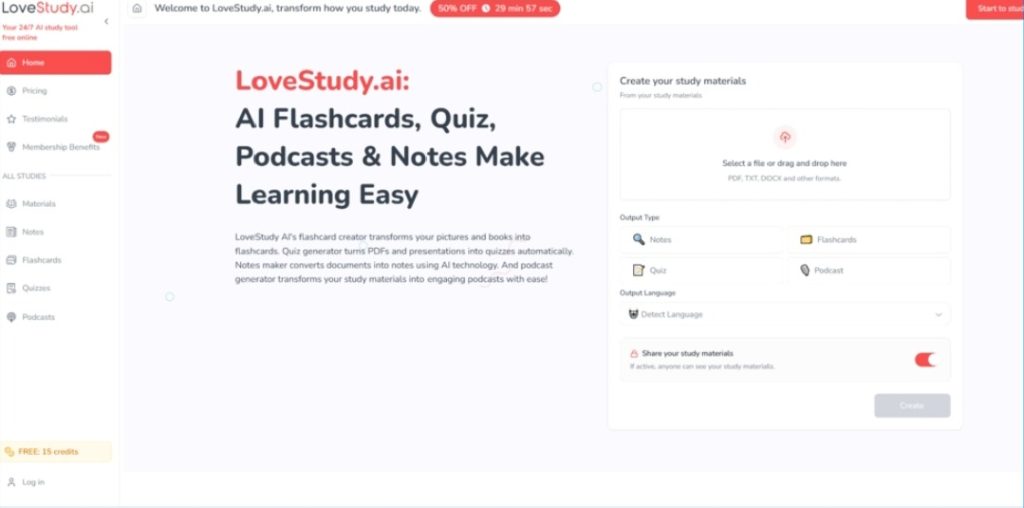
What LoveStudy.ai claims to do is simple in concept: you upload PDFs, DOCX/TXT documents, presentations, or images of notes, then generate flashcards, quizzes, structured notes, or even podcast-style audio from the same file. For an educator, that’s basically “one source → multiple learning formats,” which is the exact conversion most courses never have time to create.
The Real Bottleneck in Teaching Isn’t Explanation—It’s Reinforcement
Most courses have a good explanation layer already:
- lectures
- slides
- readings
- examples
What’s missing is the reinforcement layer:
- flashcards that target definitions and distinctions
- quizzes that check understanding under constraints
- short notes that provide a clean review path
Educators usually know reinforcement matters; they just don’t have the hours to produce it at scale.
What LoveStudy.ai Offers as a Workflow
Instead of thinking “LoveStudy AI” it’s better to think “content transformation workflow”:
1. Ingest materials
LoveStudy.ai presents file upload as the starting point and lists common formats such as PDF/TXT/DOCX (and elsewhere mentions images of handwritten notes).
2. Choose an output
- Notes
- Flashcards
- Quizzes
- Podcast
3. Generate and share
There’s also a sharing toggle (public visibility) and the pricing page suggests some plans include private results and priority generation queue—relevant for classrooms or internal training where privacy matters.
A Teacher-Centered Use Case: Converting One Lecture into a Mini Learning Kit
Let’s say you have:
- 1 lecture PDF
- 1 slide deck
- a worksheet
A practical transformation might look like:
Step 1: Notes
Generate a structured outline that mirrors your lecture’s logic:
- key terms
- main claims
- example breakdown
- common misconceptions
Step 2: Flashcards
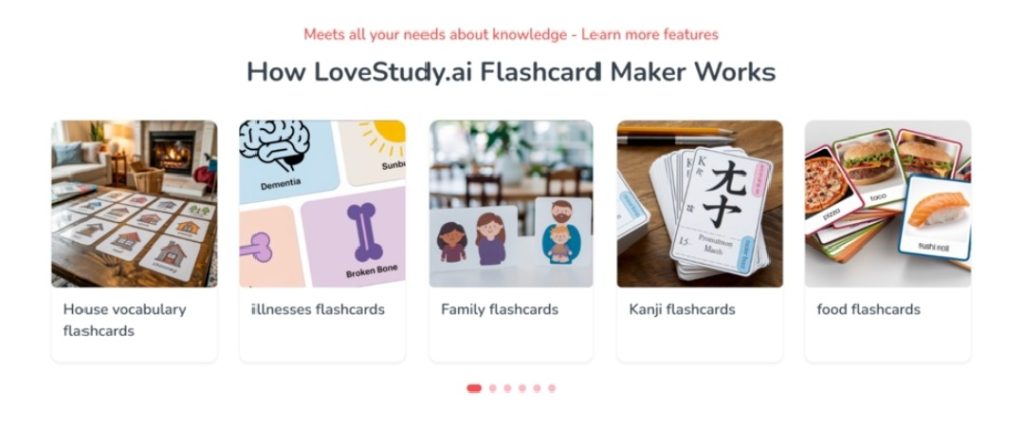
Generate flashcards that align to learning objectives:
- “Define X”
- “Differentiate A vs B”
- “What is the next step after Y?”
- “Why does Z happen in this scenario?”
Step 3: Quiz
Generate a short quiz that tests:
- conceptual understanding
- application
- common trap answers
Step 4: Podcast
Optional, but useful for accessibility or revision:
- learners can revisit key ideas while commuting
- helpful for auditory learners
Even if you only use 2 of those, you’ve created repetition and testing opportunities without writing everything manually.
Comparison Table: What You’re Really Optimizing For
| Comparison Item | LoveStudy.ai | LMS Quiz Builder Only | Manual Creation (Docs/Notion) | “Just Use Anki” (Student DIY) |
| Time to produce practice assets | Low–Medium | Medium | High | Outsourced to learners |
| Converts existing PDFs/slides | Yes (platform claims) | Often awkward | Yes, but manual | Possible, but requires formatting |
| Supports multiple learning formats | Notes + Flashcards + Quiz + Podcast | Usually quizzes only | Whatever you build | Mostly flashcards |
| Consistency across classes | High (same pipeline) | Medium | Variable | Low (depends on student effort) |
| Best for | Fast generation + iteration | Formal assessments | Small cohorts, high craft | Power learners |
| Main risk | Needs review for accuracy | Limited variety | Time cost | Uneven adoption |
The point of this comparison isn’t that one tool wins. It’s that LoveStudy.ai is trying to compress “content → practice” into a few steps.
How to Keep It Pedagogically Honest
A common failure mode with AI learning tools is letting the AI define what matters. To avoid that:
1. Start from learning outcomes
Instead of “generate flashcards,” think:
- What should learners recall?
- What should they distinguish?
- What should they apply?
Then evaluate output against outcomes.
2. Treat AI output as a draft
Even small errors can mislead learners. For high-stakes subjects, you should:
- spot-check definitions
- adjust ambiguous cards
- remove low-value trivia
3. Use iteration intentionally
If the first pass is too shallow:
- rerun with narrower scope (one section at a time)
If it’s too long:
- force smaller cards (single concept per card)
Limitations Worth Mentioning (So Learners Trust You More)
If you’re giving this to a class, it helps to set expectations:
- Results depend on source clarity
- Scanned PDFs, messy notes, or image-heavy slides may produce weaker cards.
- Sometimes it takes more than one generation
- The first output can be generic. A second pass after you tweak the input (or split it by section) often improves focus.
- AI can invent plausible-sounding phrasing
- Especially when definitions are implicit. Verification is part of responsible use.
If you acknowledge these, learners are less likely to treat the tool as “infallible” and more likely to use it correctly.
Credibility: Why Retrieval Practice Matters (A Neutral Reference)
This isn’t a platform-specific claim. Retrieval practice is widely discussed in learning science as an effective strategy for retention and comprehension. If you want a neutral overview, start here:
- https://pmc.ncbi.nlm.nih.gov/articles/PMC12292765/ (retrieval practice overview)
- https://www.frontiersin.org/journals/psychology/articles/10.3389/fpsyg.2023.1258359/full (discussion of testing effect claims)
For teaching, this translates to one practical goal: make practice easy enough that learners actually do it.
Where LoveStudy.ai Fits Best
1. High-volume content courses
When you have too many lessons to manually convert into practice.
2. Mixed ability cohorts
Notes + quizzes can create a ladder: beginners use structured notes; advanced learners drill quizzes/flashcards.
3. Accessibility-first delivery
Podcast-style outputs can support learners who prefer audio review.
Bottom Line
If you already have good teaching materials, LoveStudy.ai is not about “more content.” It’s about turning your content into practice formats—flashcards, quizzes, notes, and optional audio—fast enough to be used in real courses. You still own the pedagogy; the AI just reduces production friction. Used with light review and clear expectations, it can make reinforcement realistic instead of aspirational.



