You know your smile matters in photos. It can lift you up or leave you cringing every time a tag pops up. You may think you need major dental work to look good on camera. You do not. Small changes in how you hold your lips, teeth, and jaw can change every picture. A West LA dentist who studies faces all day sees this shift often. People rarely need a new smile. They just need to use the one they have in a smarter way. This guide walks you through six simple tweaks. Each one is easy to practice at home, in a mirror, or in a quick selfie. You learn how to soften tension, show the right amount of teeth, and use your eyes with more control. You gain choice. You stop fearing the camera and start owning it.
1. Relax your jaw before you smile
Tension in your jaw shows up fast in photos. It pulls your lips tight. It makes your neck look stiff. It can even make you look angry when you feel fine.
Use this quick reset before anyone snaps a photo.
- Let your mouth hang open for two slow breaths
- Gently move your jaw side to side
- Close your teeth so they just touch, then smile
This simple move helps your lower face look calm. It also protects your teeth from grinding. The National Institutes of Health explains how jaw tension links to clenching and grinding during stress in its overview of temporomandibular joint disorders.
2. Use a “soft close” lip position
Many people clamp their lips. Others stretch them too wide. Both can warp your smile.
Instead, aim for a soft close.
- Touch your lips together gently
- Imagine saying the word “mmm” without sound
- Then lift the corners of your mouth a small amount
This keeps you from showing too much gum or too much lower lip. It also works for kids who feel shy on picture day. You can practice as a short game. Count to three together. Then have everyone do the soft close and lift the corners.
3. Show “just enough” teeth
Teeth change a photo more than almost any other feature. Too many teeth can look forced. No teeth at all can look flat.
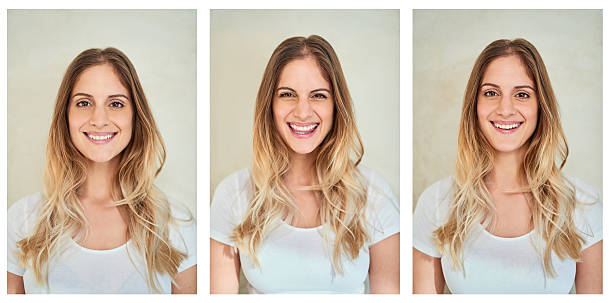
Most faces look balanced when you show the upper front teeth and hide the lower teeth. You can find your own range with a mirror.
- Smile wide and count how many top teeth you see
- Then ease the smile down until it feels natural
- Note how many teeth show at that point
You can use that number as your target in photos. Over time, it becomes automatic.
Common Tooth Display Patterns in Photos
| Teeth Showing | How it often looks | When it can work |
|---|---|---|
| No teeth | Flat or guarded | Formal ID photos |
| 1 to 4 upper teeth | Calm and steady | Most portraits |
| 5 to 8 upper teeth | Lively and open | Group shots and fun moments |
| Upper and lower teeth | Strained or tense | Laugh shots only |
4. Engage your eyes, not just your mouth
A smile that uses only the mouth can look cold. People trust a smile that reaches the eyes.
You can train this with a simple cue.
- Think of someone you care about
- Let that thought reach your eyes first
- Then add a small smile with your mouth
Your upper cheeks will lift. Fine lines at the corners of your eyes may show. That is a sign of a true smile, not a flaw. The American Academy of Ophthalmology notes how eye muscles connect to emotional expression in its public guide on eye health and function.
5. Adjust your head and neck
Face angle changes teeth, jawline, and neck lines at once. You do not need complex posing. You just need three small moves.
- Turn your head slightly instead of facing the camera straight on
- Lift the crown of your head toward the ceiling
- Bring your chin forward a bit, then down a tiny amount
This lengthens your neck. It softens any folds under the chin. It also keeps shadows from cutting across your smile. You can coach your child or partner with the same steps. Turn. Lift. Chin forward.
6. Practice a “photo breath”
Breath affects your whole face. Many people hold their breath when a camera comes up. That tightens the lips and jaw.
Use a short breath pattern before the click.
- Inhale gently through your nose for a count of three
- Exhale through your mouth for a count of three
- Smile at the end of the exhale
This relaxes your shoulders and tongue. It also keeps your smile from freezing. For children, you can turn this into a “blow out the candle, then smile” game.
When a tweak is not enough
Small smile changes help most people. Still, some issues need dental care. These can include pain when you bite, teeth that move out of place, or jaw clicks with pain.
The National Institute of Dental and Craniofacial Research lists common signs that point to a needed exam in its guide. If you see these signs, schedule a checkup.
Think of photos as practice, not proof. Each time you try these six tweaks, you learn more about your own face. You gain control over how you show up. That control can bring quiet confidence, one small smile at a time.